Tuesday, 27 August 2013

Sydney Trailwalker 2013

Originally I had intended to write this race report reflecting on how Sydney Trailwalker 2007 was my first foray into the ultra trail world, having only ever walked/jogged Woodford to Glenbrook (25km) prior, but I had too much fun on the trails this year with my team and crew to do that. So instead this is a light hearted reflection written in jest and is no way to be insulting or critical of anybody. Enjoy...

I've been known to say, "I'm not doing Trailwalker again," but that was three Sydney Trailwalkers ago. In the lead up to entries opening again for this year's event I was adamant that I would not be doing it again, but that was before Shane Simpson (a running mate from the Blue Mountains) asked me to join his team. Shane had already lined up Ewan Horsbugh and Paul Robertson. When asked I said "yes" straight away as I new it would be a fun day running with those guys.These three guys are my friends, training buddies, competitors, and now my team mates. It was probably overdue that we all came together to compete in a team event like Trailwalker. As it turned out Sean Greenhill and Melanie Parry of Mountain Sports had kindly offered to sponsor the team of Blue Mountains runners, with an invite extended to myself being a transient resident, on the condition that we get the course record.

This year's Trailwalker course was supposed to revisit Crosslands Reserve, but the bridge to the check point broke. Depending who you talk too (Grant and Marcus), it was my fault. So the course reverted back to using Berowra Community Centre as the 2nd checkpoint.
'The Bridge'. I swear it was broken before I got to the middle.
After returning from my trip to Europe the team went for a training run together. We did a run around the middle section of the course and I was surprised to discover how strong and fast the guys had become as I struggled to keep up with them and I started having doubts about my ability to stick with them come race day. Apparently what Sean and Mel had said about winning had been true and the boys had been training hard. Any thoughts of pulling out were put to bed as the team was locked in when the t-shirts were printed (GetShirty).
Team t-shirt. Can you pick the team members?
At the start line there was the usual buzz and excitement of the event ahead. Although I lived closest to the start line I still thought we could have spent more time in bed.
A quick nap before we started.
The pre-race plan was to put me in the front to dictate the pace as I'm the slowest starter. So when we started running the boys all took off and left me to chase. The team to look out for on the day was GUNN Runners GU_Newton-Nathan consisting of Jonathan O'Loughlin, Damian Smith, Ian Gallagher and Paul Gillan. Another surprise package was Steve's Holiday Xperience consisting of David Overend, David Wilson, Justin Garrett and Paul Cuthbert, who we discovered on the day had already won Trailwalker events in Brisbane and Melbourne. It all made sense as at the start they set off at a blistering pace, leading for most of the first leg. Coming into the Cowan checkpoint (CP1, 15.6km) we managed to pass Steve's Holiday Xperience to gain the lead with GUNN Runners just behind us.
Coming into Berowra checkpoint.
We maintained our lead for the next leg, which traverses bushland around Berowra Heights that I consider to be my extended backyard. At the Berowra checkpoint (CP2, 27.5km) both GUNN Runners and Steve's Holiday Xperience dropped a runner each.

As we were nearing the Bobbin Head checkpoint (CP3, 42.5km) the GUNN Runners, now consisting of 3 runners, had caught up with us. So they should as they are a bunch of very talented trail runners. In our team Shane was starting to struggle with cramps, Ewan had a spew and I hit my thigh on a tree. Paul might have done something too, but no one noticed as we were dealing with our own issues at the time. We ran in and out off the checkpoint with GUNN Runners. We pretty much ran together up until checkpoint 6 having a chat and cracking jokes at each other. It was good to run in such a big group during a race.
Coming into Bobbin Head checkpoint.
Between checkpoints Ewan was usually bludging at the back of our team. He could also have been looking after Shane and his man cramps, but we'll call it bludging in this race report. At checkpoints however Ewan wanted to be at the front to show how strong he was. We all knew he was hurting deep down.
Heading out of St Ives checkpoint. Note that Ewan was in front, intentionally.
After leaving the St Ives (CP4, 58.1km) checkpoint we were behind the GUNN Runners boys. We managed to catch them near the Cascades on our way to Macfarlane Reserve (CP5, 70.6km). In what we suspect to be a cunning ploy to sabotage our team they inentionally ran off course and in doing so took us with them. Our fault for following. The extra k's were not needed at this stage of the race and the detour was starting to take it's toll on our team both physically and mentally. Points to you GUNN Runners.
GUNN Runners explaining to Sean and Marcus how they sucked us in.
Practicing walking in a straight line. Silhouettes for next year's t-shirts?
  Although we had lost the outright lead, we still had a full team so were effectively still in first place.

Every runner had a crew member at checkpoints (Macfarlane Reserve).

Marcus showing us the way to our gear at Roseville Bridge checkpoint.
Heading out of Davidson Park checkpoint (CP6, 81.3km) we donned our head torches and headed back out onto the trail. I didn't get very far before I realised that I was running in the dark. It appeared that I hadn't charged my battery. Luckily there was a spare one amongst us and we carried on to Ararat Reserve checkpoint (CP7, 88.8km).
Last checkpoint, Ararat Reserve.
At the finish line, just before the fatigue set in.
The last leg was filled with a bit of excitement when we managed to loose the markers and orientation. This is the last thing we needed at the end of a race; to use our brains. It was hard enough to use our bodies let alone composing ourselves for rational thought. With a bit of incoherent conversation we set ourselves right again and headed for the finish.

We all ended up crossing the line in 13:24. Not quite the course record we were aiming for , but for me that was a 1 minute PB. All up not a bad day running with friends.

A big thank you needs to go out to our 'cast of thousands' support crew:
Sean Greenhill
Mel Parry
Andrew Lee
Grant McFadden
Marcus Warner + 2x Dish Lickers
Bec Horsburgh
Jackson Horsburgh
Mr and Mrs Horsburgh
and of course Brian Cardelli
Crewing can be exhausting, no matter how fit you are.
It's important that crew keep occupied while waiting for runners to arrive at checkpoints. Such activities include polishing your Western States buckle, posing for photographs, arranging each other in order of height or perhaps speed, to name just a few.

Sydney Trailwalker 2013

Saturday, 27 July 2013

Trans d'Havet 40km 2013

Initially our plan was to head home after the two races in Canazei, Italy, (Vertical Kilometre and Skyrace) but Brian always kept the option there for me to stay back to race the Trans d'Havet 80km, +/-5500m which was also the European Skyrunning Championship Ultra event. As it turned out I had an extremely good offer to stay around (for which i am hugely grateful for) and so Brian dropped me off at Recoaro Terme, Italy before heading of to Venice to catch our original flight home. Recoaro Terme was a small village outside of the race hub at Valdagno which didn't have any accommodation although it is a bigger town. More on this later.
Getting a lesson in descending from the Europeans. Photo Philipp Reiter.
I wasn't left totally on my own before the race. I was soon joined by some good company to spend the rest of the week with in the form of Ian Corless, Philipp Reiter, Martin Matthes, Lauri van Houten, Marino Giacometti and the lesser known Kilian Jornet and Emelie Forsberg. Hanging out and running with these guys was a lot of fun. The trails we were running on were very different to those I'd been spending my time on since arriving in Europe. The Alps had been very green and cool. This part of the Dolomite mountains that the Trans d'Havet trail passed were dry and hot. It was like running in summer back home. I loved it. I loved it even more knowing it was winter back home.
Checking out the area with Ian Corless. Photo Philipp Reiter.
Having run some of the course in the week prior to the event I was expecting the race to be run at a moderate pace. The course seems to be going either up or down and there were no long sections that were flat. The trail consisted mostly of loose dry dusty rocks which could catch you out if you weren't paying attention. The weather forecast for race day was for hot dry conditions which would make the run that little bit tougher.
Course recce. Photo Philipp Reiter.
The Trans d'Havet 80km race had another crazy European start time of 1am. It was complicated further by the fact that briefing would be at 10:30pm followed by a trip in a bus to the start line a couple of kilometers away. I thought I was all prepared for the logistics but apparently not. As it turned out, I left my hotel room to meet up with my lift, who had already departed. I wandered around for a bit but couldn't find anyone to give me a lift to race central or the start line. I gave Ian Corless a message, pretty much asking for HELP. Ian wasn't my savior that night, but he did suggest that I turn up later in the morning for the shorter marathon distance (40km in this case) which traverses the last half of the 80km course.

Later that morning after a restless sleep, I managed to track down Martin Matthes who was registered to do the marathon and together we traveled to race central. At the registration desk they were a little confused as to why I had registered for the 80km (which I should have already been running) and was now registering for the 40km. I was a bit embarrassed to say the least. They must think Australian's are crazy. So after receiving a new race number Martin and I boarded the bus and headed to the start line at Pian delle Fugazze. At least I was going to race today.

The marathon course measured 40km with 2500m of climbing and starts halfway along the Trans d'Havet 80km course. It was also in the same area that I had been running in the days leading up to the event so I was confident as to what lay ahead. The bus drove up the mountain side and deposited us up top, so all the big climbs on the course had been removed. It essentially became a downhill race. The field for this race wasn't particularly big, so when the race began I wasn't swamped by a crowd of over enthusiastic runners. With the late start time of 9am and the warm morning temperature everyone seemed to be content to start off conservatively.

Trans d'Havet 80km Course Profile.
The first kilometre was all on road which allowed us to spread out a bit before we hit the single trail. Martin was in front and as the field stretched out was soon out of sight. I was surrounded by runners who had all ground to a walk and I joined them power walking up the first steep climb. I passed the leading female in this session and thought to myself if I stay focused maybe I can keep this poison. It was really heating up and I was grateful for the sections of shaded trail as the next section that I had trained on is all exposed. The climb seemed to be getting steeper and steeper, but with all the switch backs it allowed me to run bits of the climb.

When we got to the top of the climb it opened up to some lovely views across the valleys and we soon descended into some paddocks that led us to our first aid station (7km) and the beginning of the next mega climb. This was the toughest part of the race. My pace had been slowed to around 20min/km. The grade of the ascent was so steep I kept slipping backwards but so was everyone else. It was hard work me, it must have been harder for those doing the 80kms. When we got to the top we were teased with a slight down hill before another huge climb to the next aid station. From this point most of the hard work had been done and it was mainly a 30km run downhill with are few shorter climbs thrown in. This downhill section was beautiful running and the views were amazing. We stayed up high undulating and weaving around the mountains for around 16km before starting to descend towards the finish line. The descent was steep and rocky and every time I looked down it seemed I was no closer to the bottom.
There were some flat sections to run. Photo by Alice Maddalena.
The trail eventually spat us out onto the road where the marshals informed me I only had 6km to go. I really noticed the heat increasing the lower I got and I think other runners did as well as I found some lying in the little water troughs that are outside some peoples homes. Knowing that I didn't have far to go I resisted the temptation to cool off and kept going. I picked up the pace just to ensure I held my position all the way to the end. I was greeted at the finish line by Martin who was waiting to take me home.

I was happy to finish in a time of 4:52:44. I think I managed to run all the frustration and some of the disappointment out of my system before finishing. Martin did well finishing in a time of 4:28:04 and bagging 4th place in the process.

Sunday, 21 July 2013

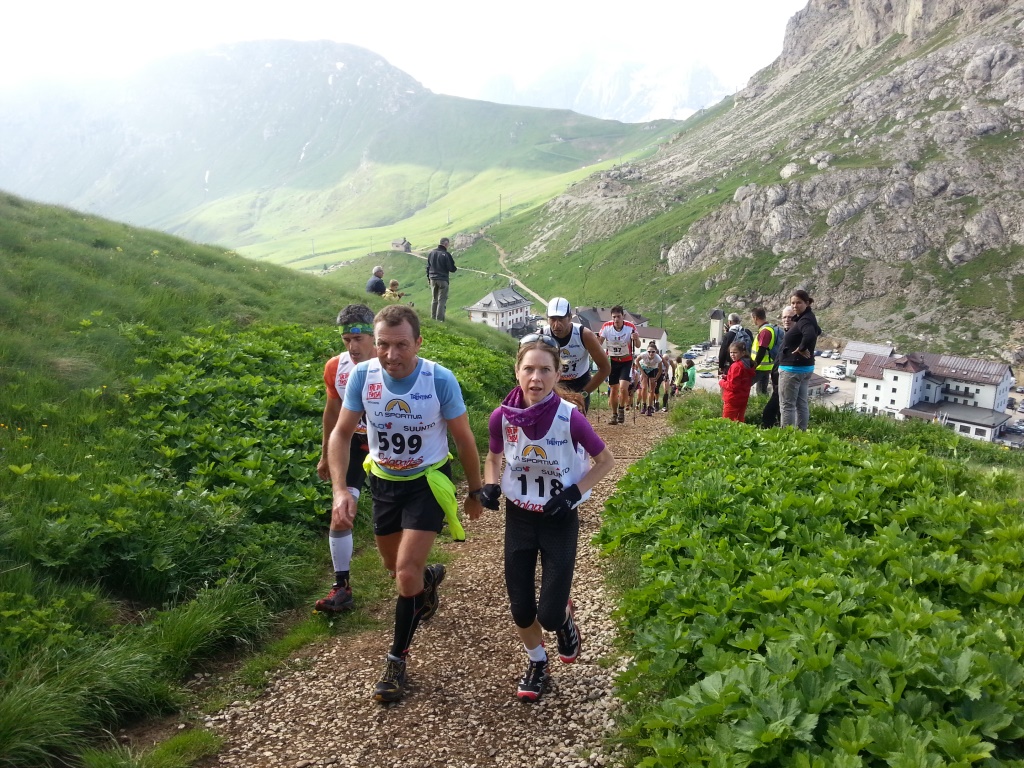
Dolomite Skyrace 2013

The Dolomite Skyrace was another race format that I hadn't experienced before. It is a 22km trail run,  this time on the other side of Canazei, Italy, to the VK, broken up into a 1750m climb over 10km followed by a 12km decent back down towards the finish. This particular race was also doubling as the European Skyrunning Championship for this particular format.

Prior to the race Brian and I had done a course recce on the first part of the course (uphill section). From what I had seen of the course didn't particularly fill me with confidence. There is one part of the course that climbs a sketchy scree slope which had large patches of snow on it up top (from the same snow fall that resulted in the Lavaredo Ultra Trail race being rerouted a month earlier in a region not far away). We got to the top of the climb and I was disappointed to see large tracts of snow extending out to the highest part of the course,  Piz Boe at 3152m. You could see that the race organisers had started to cut a trail through the snow, but it didn't fill me with confidence looking at it. I wasn't ready to face the rest of the course so much to Brian's relief we both turned around and took the cable car down to Passo Pardoi then retraced our steps back down to Canazei. 
Sketchy scree slope with snow at the top and Rifugio Forcella Pordoi.

I went to prerace briefing where they informed us that all was well on the trail (English translation seems to be much shorter and to the point compared to Italian, French and Spanish). Runners were told to expect snow up top. We were also encouraged to take gloves to help us use the ropes that had been installed on the course. Runners wishing to use poles could pick them up at the bottom of the sketchy scree slope (Passo Pordoi) then deposit them at the top (an option that a lot of people took up).
Start line.
Come race day I was pleased to have recovered from my first VK two days prior. The start of the Skyrace was a mass start with the elites again placed in an advantageous place at the front of the field, a bit like First Class with airlines.  When the race started I was startled by the speed at which the field took off. It was something more akin to a flat road race. As I'm a slow starter, and runner in general, I quickly got shuffled back in the pack.
The climb was similar to the VK, just on a larger scale. We quickly excited Canazei and its streets to follow a short section of gravel fire trail before crossing a timber bridge over the river and then the wide grassy ski runs. This is pretty much the trail up to Passo Pardoi (Brian met me here and let me know that I was 11th girl), where we cross the road and then start the climb up the sketchy scree slope. The climb up this section was a bit crazy. There were switchbacks up the slope which I had taken on my recce, but this was race day and people were intent on just getting to the top any which way. Some made a bee line straight up, others followed the switchbacks and more still did a combination of both (which was me). At the top of the climb race officials had made a snow tunnel for us to run through which was quite novel. The tunnel must have been of quality construction as there were spectators standing on top. My previous apprehension about this part of the course was replaced by the excitement of the race and I followed the long line of runners in front of me towards the highest part of the course, Piz Boe.
Passing through Passo Pardoi
The climb up to Piz Boe involved some rock climbing but at the end of the ascent it was as though I was on top of the world. After a quick refuel at the refreshment table it was mostly all down hill. I'd made top 10 by this part of the race, but I was about to have a lesson in descending steep technical trails. Coming off the mountain we followed another sketchy scree slope which had defined switchbacks in it,  but like before it was caution to the wind for most runners and they just let gravity take over. The way most people ran past me is best described as a controlled fall. I lost two positions on this section and that is where I remained for the rest of the decent down the grassy ski slopes, gravel fire trail then paved roads of Canazei to the finish line. 

I was pretty happy with my performance and finishing 12th in 2:50:53. The competition was strong and the racing was at a furious pace. The downhill technique used by the people around me (presumably all European and skiers) was impressive and something I think I could work on.

James Stewart and I at the finish.
James Stewart again joined me as the other Aussie in this race. He wasn't 100% committed to running the event the night before but woke up ready for the challenge and so joined me on the start line in the morning ready to race. He managed to get to the top of the course without being chicked, but like me got a lesson in descending. Overall James did well finishing in 2:40:24.

After I got cleaned up I went down to presentation. As the announcer started calling names he read my name out. Surely not, but yes, apparently for this race the extended podium was extended to top 15. Luckily I had washed my hair.

Below us a YouTube clip showing highlights of the Skyrace. I even made an appearance at 2:30 into the clip.

Friday, 19 July 2013

Dolomite Vertical Kilometer 2013

The next race in my 2013 'Living the Dream' trip was the Dolomite Vertical Kilometer (VK), which also doubled as the European Skyrace Championship in that discipline. I was attracted to this event for a few reasons; it is a style of race that I have not done before, it goes higher than any race I have done in Australia, it is short but very steep and I get to test myself against some of Europe's best.
In the lead up to the event Brian and I stayed at an Austrian town called Schruns, nestled in an alpine valley just shy of the Swiss boarder. The mountains around Schruns were big like most of the mountains I had seen so far in the Alps, but to my luck there was a good place to practice my straight mountain climbing skills in the form of the Europatreppe 4000. Essentially this is a series of 4000 steps running almost continuously up the side of a mountain following a now disused pipeline. The total climb is 700m and the stair does it in 1.35km of distance,  with grades of up to 86% (I didn't know what that was,  but I do now having climbed it). My first attempt was 32min. The following day I returned and  did it in 31min. Not a great improvement,  but it was better than my first attempt and I now had a feeling of what this vertical kilometer was likely to be.


 Halfway up Europatreppe 4000 looking back towards the start at the bottom.


Europatreppe 4000: all the stats, which do not make it any easier.
Turning up to Canazei, Brian and I started scoping out the slopes trying to identify where the VK will be held. On the day before the event we went in search of the start area,  which wasn't all that hard as it was already marked with a little yellow sign and if that wasn't a big enough giveaway then we only needed to follow the procession of runners with really long poles. As the race would be held less than 24 hours away I promised Brian that I would walk it,  but not necessarily stick with him. I got to the top in a casual time of 55min. I wasn't particularly disappointed with this effort. On this attempt I chose a shoe which didn't have much grip, I wasn't being pushed, didn't have poles (don't use them, don't have them and they are more likley to be a hindrance to both me and the people around me if I started using them for this event). I descended off the lofty heights of the VK course feeling confident that I could possibly do 50min, going off my improvement from the Eurotreppe 4000.
The afternoon before the VK it started to rain, a lot. I was wondering how the course would stand up to the downpour. At the race briefing they informed us that there would be start waves with groups of runners going off at 4 minute intervals. The last two groups would consist of the elite VK runners.
Come race morning the skies had cleared and it was a beautiful morning for trail running. We were organised into start groups based on our bib numbers. While we were being organised a guy with an Aussie accent comes over to me and asks if I was Beth. It turns out that there would be another Aussie in the race in the form of James Stewart from Canberra. After our brief introduction I wished him good luck before watching him line up in wave 1 an then heading off up the mountain in a flurry of poles. Looking around it appeared that I was the only person without poles. No, I lie. I did spot a few people without poles, but that was because their poles were on the ground or being held by friends who already had their own pair of poles. Well poles aren't mandatory equipment but neither are shoes and everyone had shoes on. Perhaps you needed poles for this type of running?

The finish is just 'there'.
I lined up in wave 5 as dictated by my race bib (these really were race bibs,  not just a race number). I placed myself at the back of the group, out of respect for those around me who all looked like seasoned VKer's. My expectation for this race was to just beat my time from the day before and try my best. In another flurry of poles my wave started on up the hill. I gave Ian Corless a wave as I ran past him chasing the others ahead. He seemed to look concerned and gave me a sense of urgency, something I'm unfamiliar with given my style of running. I soon caught and passed the second last runner in my group then the next and so on.

The VK course starts in a farmers paddock. The race organisers were kind enough to have mowed it prior to the race. From the start area the trail goes up, up and up. Firstly following a narrow strip of mowed grass and wild flowers on a cambered upward slope. The wild flowers quickly give way to pine trees as the hill gets stepper. There was a small bit of downhill in this section where we lose maybe 1m of elevation,  however this is brief and isn't repeated again on the course. The trail narrows as it ascends up through the pines to a narrow dirt trail. In sections this trail has foot holes cut into it to help with the ascent. Without these foot holds you would just slip on the grade. In other sections temporary stairs had been constructed using branches from the surrounding pines. As the trail continues to ascend and the pines start to thin out there are rocky outcrops that require negotiation. These would have been easier if it was just rock instead of the layer of dirt which covered them. It was also around this section that the marmot burrows started appearing. I wonder what the marmots thought as a few hundred runners with poles (me excluded) came running, tapping and panting past their front door? The pines finally gave way completely to grassy alpine slopes and a wonderful view across the valley Val di Fassa. The top section of the course is a little deceiving as the trail goes to a sadle between two grassed rocky outcrops in which the race organisers place a large blow up arch. Unfortunatly this arch is not the finish. The finish is further up on one of the grassed rocky outcrops.

1000m above Canazei.
During the race spectators had lined most of the course. They yelled,  screamed, rang cow bells and even gave runners a push from behind. It was great to have this level of support on a trail run.
I was happy the way I paced myself for this run. I started conservatively and spent the whole ascent overtaking people who were clearly tanked. My shoes clawed at the ground and held firm. I ran with gloves to help pull and push me up hill using anything within reach; rocks, trees, even grass. Don't get me wrong in thinking it was easy. It was far from an up hill walk in the forest. My breathing was labored, but under control. My legs were burning. I was pushing on both my knees with every upward step. I absolutely loved it.
As I neared the finish I could see another girl ahead of me who started in my wave. I closed in on her and although we were both very close at the end I finished a whole 9 seconds behind her. At the finish gate I grabbed a recovery Coke from the refreshment table then checked my time on the live timing TV screen that was rigged on the side of the steep slope. My time was 43:53, second behind the girl that finished just ahead of me from my start wave. James finished in 42:51 and was looking good sitting amongst the fast guys, at least that was the way it remained until the elite VK runners started their ascent. The elite men started first with the elite girls starting last. I watched the first girl (Antonella Confortola) come across the finish, then a full two minute wait for the second girl (Emelie Forsberg) then more girls started trickling over the line. James went and checked the TV screen again then came back and informed me that I'd finished 6th female. I was pretty happy with my performance, far exceeding my initial expectations. Plus I was just 52 seconds from second place, so it was a tight contest.
James Stewart and I at the top waiting for the Elites to arrive.
That afternoon I was presently surprised to find out that my exertion wasn't particularly taxing on my body. Everyone I had spoken to regarding the VK said that I'd recover in time to run the Skyrace in two days time. I'd placed a lot of trust in other people's faith and was glad that they were right.
In reflection I don't know if I could have gone faster in the VK, particularly on that course which is almost entirely power walking. Perhaps if I'd started with the elite girls they would have fought harder for their positions, and possibly me mine. Apparently poles give you a distinct advantage when climbing but that requires skill, technique and some upper body strength. I suppose the only way to find out is to give a VK another go!
I would highly recommend the VK race format to all my running friends. It is a worthwhile experience that just about every trail runner/walker is capable of competing. It is less about speed and more about determination.

Check out the Dolomite Vertical Kilometer video below. The only problem is that the video does not do the course justice. It doesn't capture the cross camber of the course on the grassy slope at the beginning or the steepness of the assent. It does however give you an indication of the effort that everyone puts in to get to the top. You might also see a shot of me at the beginning doing up my shoes.

Sunday, 14 July 2013

Ice Trail Tarentaise - Altispeed 2013

My entry into the Ice Trail Tarentaise Altispeed race wasn't exactly planned. Brian had entered me into three races prior to our departure to Europe. My first race, Lavaredo Ultra Trail (LUT), was shortened from 118km to 85km due to late snow falls. Following the LUT Brian and I discussed the idea of doing another race to 'make up' the race distance I had lost due to the altered course. We looked at a Skyrace, the Ice Trail (65km, +/-5000m, highest point 3653m) in Val d'Isere, France, which looked pretty extreme (for an Aussie girl that is). It was 64km long, run at altitude, had snow and even ice in the form of a glacier. The distance didn't concern me, although I had come to discover that distance in the mountains is negligible, it is time spent covering the distance that is all important. It was the altitude, snow and ice that concerned me most. Just about all my running is done between sea level and 1000m. I've only previously raced above 2000m at LUT and Western States. My experience running in snow had been limited to a few kilometers at Western States and more recently at LUT. The Ice Trail had a shorter version called the Altispeed (32km, +/-2500m, highest point 3386m), but although half the distance it still looked to be a challenging course. Brian and I had a friend, Marcus Warner, entered to do the Ice Trail, and to fill in our holiday we decided to head towards Val d'Isere to check out the area and even spectate at the event. After a few red wines, Brian took my interest in the event as being serious so quietly disappeared to enter me online in the Altispeed.
 
Altispeed course profile.
The week before the Altispeed race we stayed in Annecy, France, checking out the area and meeting up with people. We had the opportunity to chat with a few runners who were running the Ice Trail and others who had experience in this type of racing in snow and at altitude. The conversations I had concerned me and generally went along the lines of;
Runner: "Have you run on snow or ice before"
Me: "No."
Runner: "I would suggest you use poles to help with your stability when running on the snow."
Me: "I've never used poles before."
Runner: "Never?"
Me: "Never."
Runner: "OH........"
To say that these conversation made me a little nervous and concerned is an understatement.
The trail up to Tunnel des Lessieres
The Thursday before the event we arrived in Val d'Isere and met up with Marcus in the afternoon. Marcus had arrived a few days earlier so when we arrived he drove us straight up to Col de l'Iseran, +2770m, to start acclimatising. Col de l'Iseran would be one of the checkpoints on the two courses (Ice trail and Altispeed). From here we followed the race trail up the hill through the snow to the Tunnel des Lessieres at 3000m elevation to start the acclimatisation process. Marcus explained the science behind it while I sat down and enjoyed the view.
Acclimatising with Marcus Warner, me, Brian Cardelli
The following day Marcus had another adventure lined up for us. This time we would head up the valley to Refuge du Prarinod, then beyond up a hill until we reached an elevation of over 3000m. The start of the run followed a narrow valley before opening up to a wide grassy valley. It was here that Marcus and I decided to run up a random slope. It started off OK but quickly got steeper. Marcus stopped at about 300m of vertical climbing and I continued on a little further. We both descended on our backsides. A little further on we passed the refuge, then climbed the hill behind up into the snow. Marcus was kind enough to give me some pointers about traversing snow so I spent this time practicing. On the decent we stopped by the refuge to have a light lunch.
Acclimatising on the French/Italian boarder. Acclimatising with Marcus involves a lot of either standing and chatting or sitting and chatting. No arguments from me. It seemed to work.
Race day soon arrived and I lined up with the other runners at the start. I wasn't paying much attention to the pre-race announcements, as they were all in French, when I heard my name being called out.  I'm not sure what was said but I found myself being pushed towards the front and there I stayed briefly before the start, when I quickly got swamped by all the other runners. The first section of the run followed the road up the valley. The grade wasn't particularly taxing but after a few kilometers we quickly turned and the climb began. We climbed up out of the valley following a dirt trail with grassy slopes either side. The climb went for a while and by the time I had reached the top of the first section I'd passed the lead girl. From there we climbed further into the snow. I used my newly honed snow running skills to get to the top of the climb where we joined up with the runners doing the Ice Trail. From this point on we shared the same course until the finish line. We crested the first climb, Col des Fours (2976m), then started the decent down the other side where Brian said he would be waiting. As he promised he was there waiting for me. As I approached he gave me encouragement and we both started running up the tarred mountain road together. Other guys around all started walking on this road section, but I was determined to run as I was sure my efforts running in the snow had allowed the girls behind to close the gap. It didn't take very long for Brian to drop off and start walking too.
Photo courtesy of Ian Corless, iancorless.org
The road section was soon over and it was back to climbing the mountain proper. This next climb would take me to the highest point on the Altispeed course, Aiguille Pers at 3386m. The climb was a little surreal. The grade was too steep to run, so everyone around me was walking. As we were ascending there were skiers descending beside us on groomed slopes. Also the more I climbed the more labored my breathing became. I remember thinking to myself that this was the whole reason for coming to Europe, to run in races that are completely different to what I had run before, and that is exactly what I was getting.  
Aiguille Pers at the top middle.

The decent was pretty easy compared to the climb and I could feel my breathing improving as I went. The trail skirted around the side of a mountain, then over a few small hills before arriving at the final checkpoint, Col de l'Iseran. There was a big crowd gathered, whether because of the race or because it was a place of interest, either way it was good to get the cheers. Brian was there again cheering me on and letting me know how I was doing. The last big climb was up to the Tunnel des Lessieres, a section that I was familiar with. I knew now that I could finish strong and hold my position to the end. The climb was short, compared to the two previous climbs. When I reached the other side of the tunnel I was surprised to see the trail just drop off in front of me. There was no gentle grade down. I watched a guy in front of me start running then drop onto his bum and slide down. Obviously this was a genuine technique so I followed suite. This bit of sliding was over too quickly, and the trail veered off in a different direction so it was back to running in the snow, over another small hill, more snow, then grassy slopes towards the chairlift. The trail followed the chairlift down the hill, though less direct, with a series of switchbacks down to the valley floor and the town centre.
Tunnel des Lessieres.

I was happy with my finish time of 4:01:49. I went into this race with no expectations other than to finish. I hadn't seen much, if any, of the course. My technique and confidence on snow is next to nil. I can say that having completed the course I do feel more confident running on the snow. I also think that doing the short race was a smart move as my time at altitude was limited, minimising any effects I may have had otherwise. Just before presentation concluded Marcus Warner staggered across the finish line in 13:57:41, perfectly timed to take a photograph of the mens Ice Trail podium for his Ultra168 post.
I'm glad the MC answered his own questions because I didn't understand a word.

Below is a short video showing what parts of the trail was like. I'm in there at about 3:01. My climbing skills are just like everyone elses however I do have a unique technique when it comes to descending on snow.


Saturday, 29 June 2013

Lavaredo Ultra Trail 2013

I have to start out by thanking Gretel Fortman and her race blog from last year's Lavaredo Ultra Trail for drawing my attention to this run. My plan for 2013 was to wait until the Western States lottery was drawn to find out if I would be going to California or elsewhere. As it turned out for 2013 I would be going elsewhere. Elsewhere turned into the Lavaredo Ultra Trail, Cortina d'Ampezzo, Italy. The course looked appealing (118km with +5740m) set in the Dolomite Mountains.

 
Tre Cime already had plenty of snow before the snow fall that cause the course to be altered.
Brian and I (Brian really) organised our trip so that we would get to Cortina two weeks before race day. Arriving early would give us a chance to explore the area and acclimatise. It worked out even better because Mum and Dad would be finishing their 4 week holiday in central Italy before joining us for the race before heading back to Sydney.

Arriving in Cortina I was overwhelmed by the size of the mountains. I know I've been told that the Blue Mountains, Australia are really just small hills, and that the Snowy Mountains, Australia are just as insignificant, but having seen real alpine mountains, well they are impressive. The trails around Cortina are well set out and easy even for me to navigate, all you had to do was follow the numbered trails and the red and white trail markings. Even someone as navigationally challenged as I could do that. On our first afternoon in town Brian and I set out on the start of the Lavaredo Trail for a short run without any navigation problems. Everything about the area was just brilliant. For the whole week Brian and I logged lots of kilometers on the official Lavaredo (my race) and Cortina (Brian's shorter 46km race) Trails. To get to the far reaches of the course we utilised the local buses which were easy to use and allowed us to extend our range.
Forcella Giau which was another part of the course that still had snow on it during my earlier training runs.

On our trip we scheduled a forced taper period in the form of a few days in Venice. It was hard going from a region like Cortina where the mountains are constantly calling out to be run, to a place like Venice where running at times other than first light in the morning is impossible because of the crowds. The only benefit of Venice was that I got plenty of practice using the navigation menu on my Suunto Ambit 2 GPS watch. There was plenty of extra kilometers logged trying to navigate my way around Venice's crazy layout.

When I returned to Cortina on the Wednesday before the event we found out that they had had a recent now fall of around 30cm up on the higher sections of the course. This wasn't helped by another follow up snow fall before the event which was causing race organisers grief. On my previous recce runs I was already aware that there was plenty of snow still on the course and that in parts the race organisers had cleared sections of the course. These more recent snow falls however were jeopardising the race itself. The race was originally scheduled to start 11pm on Friday night. All day Friday there were updates being posted on Facebook (mostly in Italian which added to the confusion), but before the 6pm briefing it was announced that the course would be altered and the start delayed until 8am the following morning. In my frustration I went for a run, which in hind sight probably wasn't the best idea as I went further than was planned. At briefing the race organisers said that they had to concede to the course conditions and in the interests of all competitors shorten the course to 85km, +/-3000m and avoid certain sections of the original course that were heavily affected by the recent snow falls.
There was no snow up there when we left for Venice.
I was hugely disappointed that I wouldn't be racing the entire course. I also felt sorry for the race organisers that through events completely out of their control they were forced to make such drastic changes to both their events; Lavaredo and Cortina Trails. I didn't feel entirely robbed however as I was fortunate enough to have traversed the majority of the course on some pristine days.

So on Saturday morning I lined up on the start line with all the other anxious runners ready to run. After a short musical piece the countdown began then we were off. The race was a real community event and from the start line in the centre of town the race heads up the main street of Cortina which was lined with more people cheering than at any other event I had been to to date.

The start/finish chute in the centre of town.
It wasn't long before we headed up on to the trails and in to pine forests. We climbed up several hundred meters before the trail leveled out and skirted around the mountain with glorious views of the d'Ampezzo valley. At this stage I was sitting comfortably with the other lead girls in the race, but as the race developed I felt myself starting to lag. I was just starting to feel flat. At first I thought I could run it off, so that's what I did for the next 10-15km's, but it wasn't working. I thought about the food and drink I had been consuming and it wasn't any different to what I normally do in training and in races. It couldn't have been the altitude as we weren't that high. Even so, I had been training at a higher elevation the weeks before the race and the highest points of the course had been removed, so the average race elevation was lower. I just wasn't sure what was happening. I had in the back of my mind, Western States 2011, where I felt sick, although there I thought I knew the reason and also the solution. The result in this race was that I started to slip back down the field.
Lago Ghedina, one of the checkpoints.

I'm a strong believer that ultra events go long enough that when disaster strikes you still have the distance and time to sort yourself out. In this instance I pulled back a gear to help compose myself. It was frustrating having other girls run and even walk past me but I just couldn't push to stay with them. There was one section of the trail at about 55km where I had had enough. If there was a checkpoint there and then I probably would have called it quits. Instead I did something I had never done before in an ultra which was to lie down. I walked off the trail and found a small patch of soft grass under a tree and just laid down. Gee it felt good. Laying there with my eyes closed it felt like 'nap time', and for those that know me well, that is an important part of my training/day. After a few minutes I got up, brushed myself off and was ready to make up some places. Running back on the course felt remarkably different. It was as though the gun had just gone off, only now it was a 30km race and not an 85km race and the girls ahead had a good head start. Looking ahead I could see a girl ahead and focused on closing the gap to her. I passed her on the climb and she must have thought I was running a different race. She had passed me not too long before my nap and saw the way I was feeling. Now I felt different, rejuvenated.
Lago Misurina with Tre Cime in the background.

The last 20km or so of the altered Lavaredo Trail joined up with the last 20km of the Cortina Trail which we shared to the finish line. It was refreshing to have this second wind while passing other runners. As we passed each other I would encourage them in English while they would encourage me in Italian mostly, I think?. We didn't have to understand what was said as it was the way we were saying it that conveyed the message. We had all shared the trails and had similar journeys, and given mother natures recent medelling we were just glad to be participating.


I managed to move my way up from 7th to finish on the extended podium in 4th place with a time of 10:16:10. Brian finished his first ultra in more than 2 years, covering the 46km Cortina Trail in 6:37:08.
Presentation.

In reflection I would like to think that I could have run faster and done better. I've had some time to think about why I was feeling flat and I still don't have an answer. I didn't have the same problems in the following races I did in Europe. Even though those other races were shorter I had none of the symptoms  during or after the races. I've since spoken to some other Aussies who were racing in Europe and they said that they'd experienced similar issues. I suppose that is the nature of ultra running. You are pushing your body to the extreme to test the limits and when doing this sometimes unwanted things can happen. When I start having consecutive 'perfect' races I'll think about doing some other sport. 

Here is a short video of the Lavaredo Ultra Trail by The North Face.  


Monday, 20 May 2013

The North Face 100 - 2013


What really impressed me with this year’s TNF100 event was the sheer number of PB's from repeat offenders and top performances by newbies on this course.

I have a certain affinity with this event. It is in the Blue Mountains and I love the Blue Mountains. It traverses some of my favourite locations with stunning views. It was my first 100km event and first big ultra. I ran in the inaugural event (2008), which was held shortly after I started running. During the first event all I could think about was just finishing and perhaps getting a silver belt buckle (then available for sub 20hr finishers). I trained as hard as I could and was absolutely stoked to finish, and more so to have done it in 15:30. The lead guys and girls in that year’s race managed to finish in 10:22 and 12:45 respectively. I was in absolute awe of their athletic ability and couldn't comprehend how people were capable of traversing such difficult terrain in the times they did. They must have been exceptional athletes to accomplish such incredible times.

After the first year there were rumours that the event might have been a one off, but I was thrilled when entries opened and I was once again training for this epic event. I must have been one of the first to put an entry in. The number of entrants grew and along with it the sport. Reflecting on it people trained harder, gear was more developed and people in general became smarter in the knowledge of how to tackle this beast. This particular year my goal shifted from just finishing to getting another silver belt buckle (now only for sub 14hr finishers). I wasn't sure what I was going to do with a second belt buckle, as I only have one waist, but I wanted another one for what it represented and a new PB in the process. I suppose what I really wanted was to achieve a new goal that I felt was within my reach. My finish time that year was 13:36 and my goal was realized. To top it off I was lucky enough to make the podium to claim second place but I was still a long way from Julie Quinn who was out front pushing the limits to set the first of her female course records at 12:13.

Come the following year the event was building a solid base of runners. My goal was once again simple; as always to just finish. I had trained a little more for this race and was confident of another PB. I was a little shocked when I dropped down into Jamison Valley with Julie in equal first. I had never been in this situation before and wasn't too sure on quite how to handle it. My approach was to keep running within my own limits and what ever happened so be it. Climbing out of Jamison Valley I spent the whole time power walking/running scarred thinking that my lead would be gone in an instant when Julie caught me but she didn't. I was over the moon with my result. At the time it was the pinnacle of my running career. I didn't care that I had fallen short of Julie's female course record by 3 minutes as I had achieved something which just a few short years before I had thought was above and beyond anything I could attain.

The following year in 2011 I was sidelined with injury. It was probably the worst year to miss running TNF100 as the race had attracted a good contingent of international trail runners in the form of 'Team Salomon'. I watched the race from the sidelines and what really impressed me was Julie Quinn's performance. She ran the whole day behind the leading females only to dramatically close the gap in the second last leg, then to capitalise on her gains by taking second then first place to secure the win and the female course record in under 12hrs (11:39). Julie's performance that year reinforced in my mind how important it is to focus on your own race in order to achieve your own goals.

My goal this year was to focus on myself and try to finish in a time that I thought was attainable. I felt during this year’s race things went a little better than in previous years. My running felt more fluent. The gear I had performed better. My serviced checkpoints were measured in what seemed like seconds instead of minutes.

If you look hard enough you can see my legs.

Race morning was pretty chilly, no different to any other year. The Fairmount (race HQ) was buzzing with runners full of pre-race nerves. It was great to see so many spectators along the road cheering us on. The first section is quite technical with lots of stairs and single trails which makes it difficult to pass. Hanny Allston was just behind me and polity asked the guys in front if she could get through. I pulled over to let her pass but she declined the offer and said I was fine, how sweet of her. Hanny finally had enough of being behind me and took off shortly after CP1. She flew down Narrowneck. She looked so strong and powerful. I felt so weak in comparison. Shona was out in front at that stage and Hanny was not far behind. I wondered as I lost sight of them both how long Shona could hold Hanny off. I caught my good friend and training buddy Shane Simpson near Tarros Ladders, the same spot I caught him last year and at the same Shona. It’s funny how the years repeat themselves.


Ironpot and Megalong Valley passed without any problems and I ran into CP3 to the cheer of my supporters. Mum and Dad were there along with Brian, my aunt and uncle (Sally and Martin) along with the Berowra Bushrunner crew who were out supporting other runners on the course, and the rest of the friendly faces who form the ultra running fraternity.

Going up Nellies I caught up to Hanny where she informed me she was pulling out with an injury and wished me luck for the rest of the race. Hanny had only just decided to step up to the 100km at the last minute to give it ago. With her A race being the Orienteering World Championship in a few weeks’ time she made a wise decision to pull out. It was great to meet Hanny and I hope to race with her again in the future.


I
n the later sections of the race I found myself catching up to some of the top guys. A few of them had a disappointed look in their eyes as I neared them. I think it was the fear of being chicked. Coming up Kedumba Pass I caught Grant Guise who by this time had lost the spring in his step. Grant wasn’t going to let me go on the steep fire trail so we stuck together which made the climb a lot more enjoyable. We Passed Mick going up Kedumba, he didn’t look amazing but better than when I saw and passed him at a similar place last year.

Grant and I moving too fast for the cameraman. 

Chris Truscott and Matty Abel passed us near the top of the Kedumba climb but Grant and I were very efficient at CP5 and left before both of them. This was the first time I talked about my race goal with Brian, my husband and crew. He said I was still on target but would have to run hard to get it. The last leg is very technical and really does drain the last of your reserves. I put in a massive effort on this last stretch trying to keep with Grant, Grant found a second wind and started flying off and Chris Truscott caught us again. I told Grant to leave me and chase him but I guess my company was too good and he chose to stay. I didn’t want to lose him and he didn’t want to drop me. Together we made it to the finish line and literally fell over it (in a poor attempt at a leap-frog) in 11:01. Thanks Grant!

My run-up before crashing into Grant Guise.

When I talked to runners following this year’s TNF100 I feel a real affinity between their successes and mine on this course. As tough as this course is, it’s the feeling of overcoming seemingly insurmountable obstacles that gives us the biggest rewards. For me it is going from a simple goal of finishing in my first attempt to my most recent result. Though finishing with a time if 11:01 is oh so close to my ultimate short term goal. Oh well there is always next year.

Well done to Brendan Davies who scored a massive PB and CR (amazing!). Also well done to Joanne Brischetto placing 2nd Female in her first ever 100km.

Ladies Podium, Shona, Beth, Jo.